
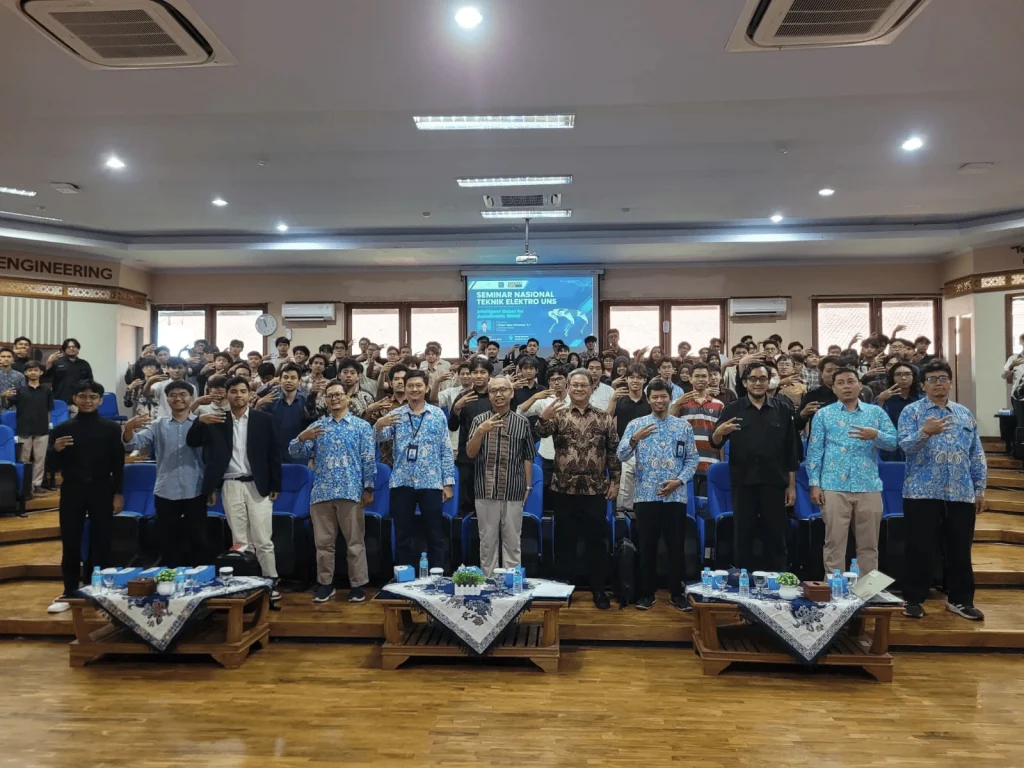
Surakarta — The Electrical Engineering Study Program, Faculty of Engineering, Universitas Sebelas Maret (UNS), held a National Seminar and Workshop themed “Intelligent Robot for Sustainable World” on Wednesday (7/10/2026), at the Main Seminar Room of the UNS Faculty of Engineering. The event opened with remarks from the Dean of the Faculty of Engineering UNS and a representative of EZRA Robotics, while inviting participants to understand how intelligent robots can address real-world challenges toward a more sustainable world.
The main session was delivered by I Wayan Agus Darmawan, S.T., Robotics Systems Lead at PT Ezra Robotics Teknologi. He opened the session with a fundamental question: what exactly is a robot? According to him, a robot is not defined by its form or level of sophistication, but by its ability to sense its environment, make decisions, and then act in the physical world. Based on this definition, robots can take many forms, ranging from robotic arms, legged robots, drones, aquatic robots, exoskeletons, and medical robots to humanoids.
Participants were also invited to explore the components of an intelligent robot, namely sensors, computers, actuators, as well as power and networking systems, which work together in a sense think act cycle. The speaker emphasized that robotics is an intersection of multiple fields, meaning that students from various engineering disciplines have a place within the field. He also explained that modern robots are increasingly trained rather than programmed line by line, through reinforcement learning and training in simulation environments before being transferred to real robots.
The speaker also explained that robots have played a tangible role in 12 of the 17 Sustainable Development Goals (SDGs). Examples include weed-removal robots for agriculture (SDG 2), surgical robots and rehabilitation exoskeletons in healthcare (SDG 3), river and beach waste-collection robots (SDGs 6, 12, and 14), solar panel cleaning robots (SDG 7), and post-disaster mapping drones (SDG 11). He also shared EZRA Robotics’ experience in developing electrical substation inspection robots, AI robots with voice commands operating over 5G networks in collaboration with ITS and Indosat, as well as autonomous patrol robots for public buildings.
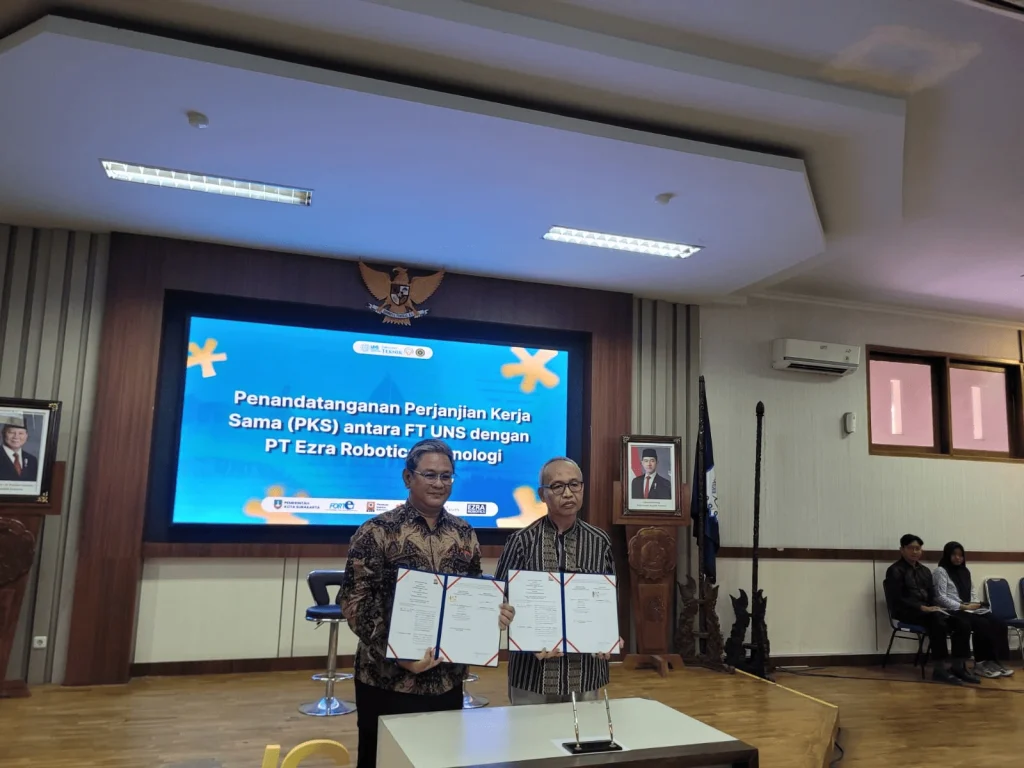
The session concluded with the message that the best robot is not necessarily the most sophisticated one, but rather the one that solves a real-world problem. Participants were encouraged to choose a development goal, identify the problems behind it, and only then build the robot. The event continued in the afternoon with the Mastering Quadruped Robot Workshop.
Through this event, the Electrical Engineering Study Program at UNS hopes to further encourage students to develop robotics innovations that provide benefits to society and the environment.