
Surakarta — Situkar, an innovative business developed by students at Sebelas Maret University (UNS), has successfully introduced a Reverse Vending Machine (RVM) as a solution for managing plastic bottles, cans, and beverage packaging waste using environmentally friendly technology. The development of this RVM is supported by funding from the UNS WIBAWA Program 2025, a program that encourages the emergence of technology-based and sustainable entrepreneurship innovations within the UNS environment.

The SiTukar team is ready to demonstrate the platform at the WIBAWA 2025 Demo Day booth.
The development of Situkar was initiated by a team of students from the Electrical Engineering Study Program, Faculty of Engineering, Sebelas Maret University, consisting of Daffa Izazudin, Abdee Ridho Pramono, Ahmad Fadlan, Imam Ihsanudin, Inzaghi Zafran Aditya, and Irfan Nahar Hidayat. The entire design and development process of this innovation was supervised by Ir. Agus Ramelan, S.Pd., M.T., a lecturer in Electrical Engineering at UNS.
The Situkar Reverse Vending Machine (RVM) is designed as an automatic waste sorting machine that can identify, sort, and digitally record waste types. This system allows users to exchange used plastic bottles and cans for points or incentives, thereby encouraging active community participation in waste management while creating economic value from inorganic waste.

The SiTukar team at WIBAWA 2025 Demo Day.
Technically, RVM Situkar integrates sensor technology for material identification, a microcontroller-based smart control system, and structured digital data recording. This combination of technologies enables a more accurate, efficient, and transparent waste sorting process, while minimizing sorting errors that commonly occur in conventional systems. The data generated by this machine can be used as a basis for evaluating waste management by facility managers, educational institutions, and local governments.
Situkar promotes a green technology and circular economy approach, where waste is no longer viewed as final waste, but as a resource that can be managed and reused sustainably. The presence of this RVM is also intended as a means of environmental education to raise public awareness of the importance of waste sorting at the source.
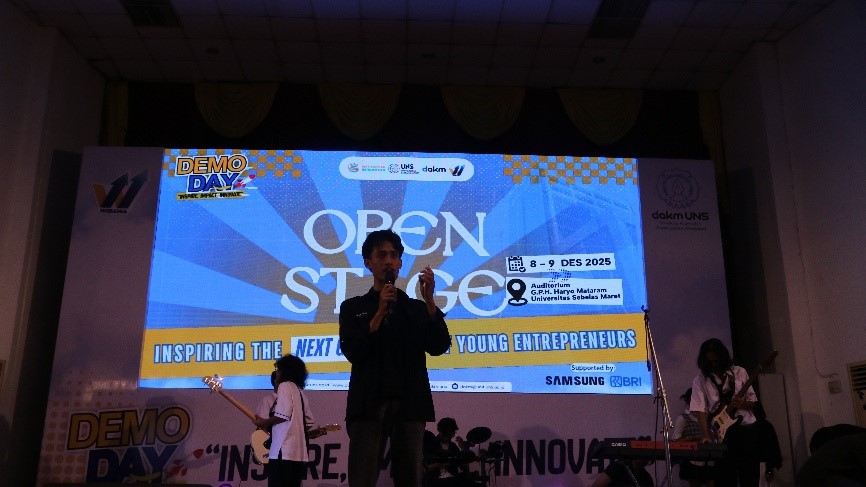
Abdee Ridho Pramono giving a presentation on reverse vending machines during the Open Stage Demo Day WIBAWA UNS 2025 session at the GPH Haryo Mataram Auditorium.
Abdee Ridho Pramono, as the representative of the proposing team, said that support from the WIBAWA UNS 2025 Program was a key factor in accelerating the development of the tool.
“Funding and assistance from the WIBAWA UNS 2025 Program enabled us to develop the RVM prototype more optimally, in terms of sorting accuracy, control system reliability, and the readiness of the device for use in public spaces,” he said.
Through this funding, the Situkar team strengthened product engineering, field system testing, and the development of a business model based on the sale of Reverse Vending Machine units. In the future, Situkar aims to collaborate with universities, schools, offices, shopping centers, public areas, and local governments as strategic partners in the implementation of a modern waste management system.
The WIBAWA UNS program is a Sebelas Maret University entrepreneurship development program that aims to foster applied technological innovation with a real impact on society. Situkar’s success as a funding recipient reflects the active role of UNS students, with the guidance of lecturers, in providing concrete solutions to environmental problems. With the developed Reverse Vending Machine innovation, Situkar is optimistic about contributing to waste reduction targets, increasing public awareness and participation, and accelerating the implementation of technology-based circular economy in Indonesia.